

Blog
A Guide to Avoiding Pitfalls in Brushless Power Tool Drive Solutions | WUEN TOOL’s Comprehensive Mass Production Experience

With the automation upgrades in industries such as garden pruning, garment textiles, and sheet metal processing, brushless electric shears, with their advantages of long lifespan, high efficiency, and low noise, have completely replaced traditional brushed electric shears and become the industry mainstream. The cutting accuracy, battery life, operational stability, and mass production reliability of a brushless electric shear all depend on the underlying brushless electric shear drive solution.
WUEN TOOL
Brushless power tools
Operational stability and reliability
I. Core Value of Brushless Electric Scissors Drive Solution
Compared to the drive structure of traditional brushed electric scissors, the brushless drive solution achieves precise commutation control through an MCU main control chip, completely solving the pain points of brushed motors such as carbon brush wear, spark interference, short lifespan, and high maintenance costs. The mature brushless electric scissor drive solution can achieve precise control of torque, speed, and start/stop in all dimensions, while integrating a full-link protection mechanism. This not only improves the performance ceiling of end products but also reduces mass production and after-sales risks, making it a standard core component of mid-to-high-end brushless electric scissors.

II. Common Core Parameters of Mainstream Brushless Electric Scissor Drive Solutions
Currently, mature, mass-produced brushless electric shear drive solutions on the market have established universal parameter standards covering all scenarios, adaptable to the product needs of most niche applications. Key parameters are as follows:
- Wide Voltage Adaptability: Supports 5V-28V wide voltage input, compatible with 1-7 series lithium battery power supplies, covering all product categories from handheld portable models to high-power industrial models, eliminating the need for redundant hardware architecture development;
- Power Output Performance: Peak current supports software adjustment from 10A to 30A, no-load speed adjustment range 0-20000RPM, torque fluctuation ≤3% across the entire range, ensuring no shearing force attenuation under high and low speed conditions, adaptable to shearing materials of different thicknesses and hardness;
- Comprehensive Protection Mechanism: Stall protection response speed ≤5μs, integrating overcurrent, overtemperature, undervoltage, and short-circuit hardware + software protection, instantly cutting off power output in case of stall or material jamming, avoiding problems such as board burnout and gearbox damage, significantly reducing mass production after-sales rates;
- Low power consumption control: Static power consumption in sleep mode is ≤10μA, completely solving the pain point of standby power depletion in handheld battery-powered products. With the same battery capacity, standby time and continuous use battery life can be increased by more than 30%.
- Compliance design: Both hardware and software are EMC optimized, meeting EN 55014 and GB/T 17626 standards. It can pass mainstream certifications such as domestic 3C, EU CE, and North American UL in one go, avoiding the rectification costs and time delays before product launch.
III. Segment-Driven Solution Selection and Matching Guide
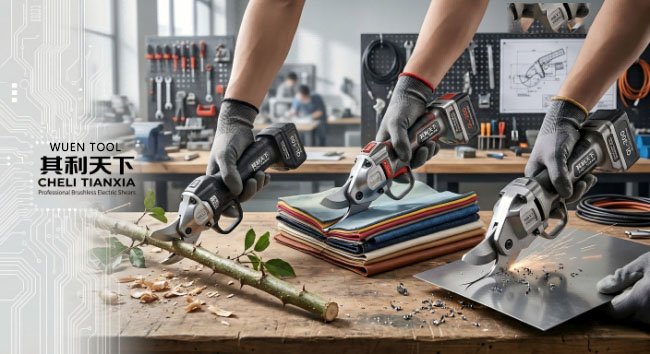
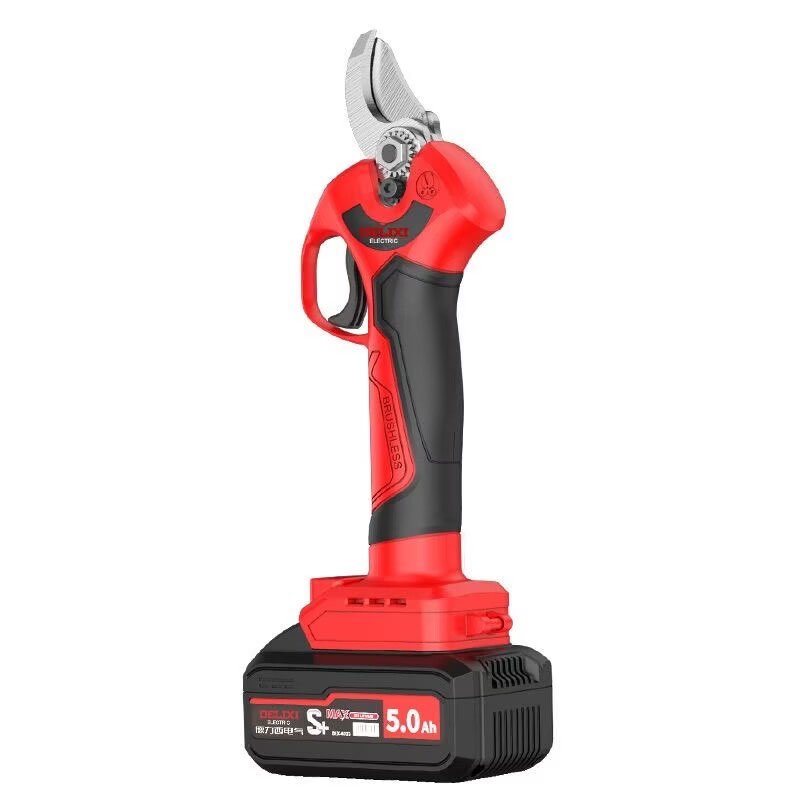
Brushless Electric Pruning Shears for Gardens: The core requirements are high torque, wide temperature adaptability, and long battery life. Mainstream models use 18V/21V power supply, with a peak current exceeding 20A. The operating temperature range is -20℃ to 65℃, making it suitable for outdoor high and low temperature environments. It also supports multi-level torque adjustment to meet the pruning needs of branches of varying thicknesses. WUENTOOL has specifically optimized torque output stability under wide temperature conditions for outdoor garden scenarios, making it adaptable to extreme outdoor environments. It also supports multi-level torque adjustment to meet the needs of all garden pruning scenarios.
- Brushless Electric Scissors for Garment Cutting: The core requirements are stable speed, precise start-stop, and low noise. Mainstream models use 5V-12V power supply, with speed fluctuation ≤2%. They feature soft start and progressive torque output to prevent fabric deviation and uneven cuts. Electromagnetic interference is also optimized to avoid affecting other precision equipment in the workshop.
- Brushless Electric Scissors for Industrial Sheet Metal Cutting: The core requirements are continuous high-load operation, controllable temperature rise, and strong anti-interference capabilities. Mainstream models use 24V-28V power supply, with a peak current of 30A and a continuous operating temperature rise ≤40K. They feature intelligent over-temperature derating protection, making them suitable for 24-hour continuous operation in factories. They also possess strong anti-interference capabilities, adapting to complex industrial electrical environments.
Brushless Electric Scissors Drive Solution Selection Guide:
Avoid simplified solutions with inflated parameters: Many low-priced solutions only list no-load peak parameters and do not provide continuous load test data. In actual use, shear force attenuation and sudden speed drop occur as soon as a load is applied. Selection must be based on actual test data under full load conditions.
Avoid solutions lacking protection functions: Some solutions, in order to cut costs, only retain single overcurrent protection, omitting stall, over-temperature, and short-circuit protection. During mass production, this easily leads to problems such as material jamming, board burning, and complete machine scrapping, resulting in a high after-sales rate.
Avoid solutions without compliance design: Drive solutions without EMC optimization are prone to certification failures, preventing product launch and wasting all initial R&D investment. Prioritize solutions with mature certification cases.
Avoid solutions with poor mass production compatibility: Some solutions can only adapt to a single motor model. Later, when changing motors or upgrading products, hardware and software modifications are required, significantly lengthening the R&D cycle. Prioritize mature solutions that can be fine-tuned via software to adapt to different motor parameters.